
Some firms with 20 employees are still undeniably small. Some with two have already lost the plot. Here’s what “small” really means in the world of accounting.
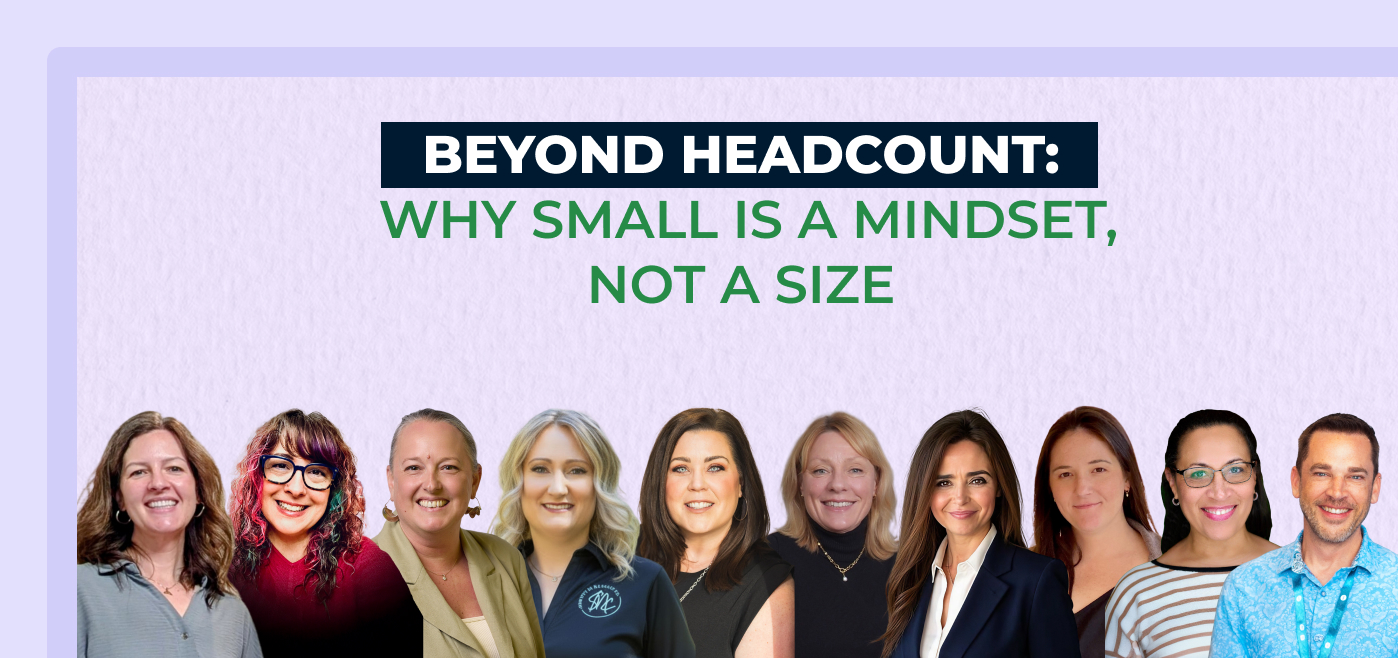
Cathryn Vidal has a team of six. Melissa Miller Furgeson has two. Anne-Marie Kaden has ten. Laraine Hutcherson has 15. Tyler Otto has 16.
All five of them would describe their firm as “small.”
Vidal, the founder of British Columbia-based Crema Bookkeeping, has thought carefully about her firm’s growth trajectory. She’d like Crema to get bigger—after all, she recently moved into a new office with rooms she hasn’t filled yet—but she can clearly describe the ceiling at which continued growth would actually detract from the firm’s success.
 Cathryn Vidal
Still, she can’t really put a number on that threshold. There’s no specific revenue milestone, client count, or team size that would definitively push Crema into “too large” territory. Instead, it’s more of a feeling—one rooted in the quality of the team’s relationships with clients and with each other. And one rooted in the intentional choices Vidal has made about what to protect as the firm evolves.
Small is not a stepping stone
Most successful small accounting firm owners can tell you, in some detail, why they stopped where they stopped (or why they haven’t actually defined a stopping point).
For Miller Furgeson, who runs Chicago-based Bookkeeping for Good with one full-time employee and about 25 clients, it all goes back to why she started the firm in the first place.
 Melissa Miller Furgeson
Katie Helle’s pathway to firm ownership followed a similar trajectory. She spent 15 years at a traditional firm before founding Scaled Accounting Solutions, and from the very beginning, she designed the business specifically to avoid the things that burned her out as an employee.
 Katie Helle
It isn’t that big firms are inherently bad, Helle explains. It’s just that she’s all-too-familiar with the tradeoffs that come with scale, and those are tradeoffs she’s simply not interested in making.
“When you have a large team, you sometimes run into headaches and you end up working more than you thought you were going to work,” Helle says.
Alisa McCabe knows all about those headaches. Her firm, First Steps Financial, once had around 100 clients. Now, that list has shrunk to 41—thanks to a very intentional “pruning” effort McCabe herself spearheaded. Her goal? To work only with the clients she actually wanted to help.
Hutcherson, by contrast, is perfectly comfortable with a team of 15 people and a client roster 80 to 100 strong at Strength In Numbers Co. But she still talks about the business the way a solo practitioner would—and that mindset is the defining characteristic of the firm’s identity. Like many other small firm owners, Hutcherson is ultra-selective about the clients her team takes on.
 Laraine Hutcherson
And then there’s Kaden, whose firm scaled up much faster than some of the others featured here: Tiny Paws Bookkeeping grew from roughly 30 clients to 60 to more than 100 in about three years. And unlike some of her peers, she doesn’t really have a limit in mind.
“I don’t know if there’s a place that’s too big,” she says. “I certainly feel like what I have is what I can manage right now, but that doesn’t negate finding the right person to manage it and start building the next group of people that come in.”
Yet, Kaden also serves one of the narrowest niches—one she was personally part of for many years: the pet care industry. So for her, the work still feels extremely personal, and she manages Tiny Paws from a place of great empathy and care. No matter how many clients she has, the experience and level of service she delivers is not something she is willing to compromise on. And that’s why, regardless of size and scale, her firm remains unequivocally small.
Small means clients are people, not accounts
At a certain scale, clients become accounts. They get assigned, routed, and reviewed—often in a cold, clinical manner. Small firms view client relationships differently.
Lynn James-Young, who founded Bring It Bookkeeping from her kitchen table, now has clients in more than five states and partners running branches in two states. Despite that growth, she still makes a point of personally meeting with every client on a quarterly basis.
 Lynn James-Young
Angela Jenkins built Philadelphia-based Mindfull Money Matters around one non-negotiable filter: “I work with people I like,” says Jenkins, who now serves around 15 clients, all of whom she has a personal relationship with. “If I get a good vibe from you, I’ll want to work with you.”
Getting to know clients as people also enables you to serve them better—sometimes in ways that have nothing to do with accounting. Dave Kersting, for example, has baked “connection-making” into his firm’s DNA. He launched Capovario around the start of the pandemic, and from the very beginning, he recognized the unique opportunity to facilitate networking among different clients on his roster. For example, he’d been talking with one client who mused about wanting to make a reality show. He was separately working with a ghostwriter who had contacts at Netflix, and separately again with a production manager who handled film and television work in California. Naturally, it dawned on him that the three of them might have a lot in common.
“These three people need to meet each other,” Kersting remembers thinking.
So, he introduced them. And the next thing he knew, they were creating a reality TV show together.
Those kinds of connections just don’t happen in large, corporate behemoths. And for Kersting, that’s a differentiator. He’d go so far as to say it’s part of the actual product his firm offers.
Something else that clearly distinguishes small firms from their larger counterparts is their focus on the emotional side of finances. Kaden, for example, spends a surprising portion of her week simply calming her clients’ fear and anxiety.
 Anne Marie Kaden
Small means accounting team members are more than employees
Larger organizations create roles and then hire people into them. But many of the firms featured here did the opposite: they found the people first, then shaped the firm around them.
Strength in Numbers is perhaps the strongest example of this approach to team-building. Hutcherson started the firm because raising four children under five, including two with disabilities, made holding down a conventional job pretty much impossible. As the business grew, it began attracting people in similar circumstances.
Laraine Hutcherson
Word of Hutcherson’s carefully cultivated work environment traveled fast. Without ever posting a job ad, she now has a hiring pipeline that runs solely on reputation, an entire folder stuffed with unsolicited resumes, and a steady stream of emails from people hoping something opens up.
Culture is also a North Star for Kersting and the Capovario team. In fact, the firm supports what he calls “passion projects,” where team members choose causes they care about, and Capovario pledges financial support—whether or not it has anything to do with accounting.
 Dave Kersting
One team member, for example, noticed that some of the women at her church’s knitting group couldn’t afford supplies. Kersting told her to go buy them—and to make it clear the gift came from her, not from him. Beyond individual projects, the firm gives 15% of its annual income back to the community in the form of discounted or donated services.
Kaden perfectly captures the underlying human-driven philosophy shared by Kersting and so many other small firm owners: “We need to treat them as people first and as employees second,” she says.
Christine Salvatore takes that principle one step further at her firm, In Line Management. In addition to treating her employees as people first, she vows to always put them first—even if it means upsetting a client or losing business.
 Christine Salvatore
What Small Accounting Firm Owners Refuse to Compromise On
Melissa Miller Furgeson and the affirmation clause: Every prospect at Bookkeeping for Good must explicitly affirm the rights of the LGBTQIA and BIPOC communities before an engagement begins.
Lynn James-Young and the quarterly meeting: Every client meets one-on-one with James-Young every quarter, whether by phone, via Zoom, or in person.
Dave Kersting and the passion projects: Capovario helps fund the community give-back efforts team members care about most, business-related or not.
Anne-Marie Kaden and leading with compassion: Clients often arrive frightened of their own numbers. Tiny Paws treats those conversations the way you’d approach a scared animal: slowly, gently, and without judgment.
Small means the owner is still close to the work
Most small firm owners have built their businesses from the ground up, brick by brick. The majority started as sole proprietors, and they’ve put countless hours into forging deep, personal relationships with their clients. And even as they’ve added team members, they’ve stayed close to the work.
But staying close to the work and refusing to let go of the work are two very different things. Firm owners who recognize and honor that difference set themselves up for smooth, sustainable growth. Those who don’t set themselves up for a lot of unnecessary stress.
Otto learned that lesson the hard way, by his own humble admission. His team at Specialized Accounting has spent the past year systematically pulling tasks out of his hands, galvanized by a rally cry they eventually turned into a hashtag: #removethebottleneck. He knows the shift is 100% necessary, but that doesn’t make it any less uncomfortable.
 Tyler Otto
The good news for owners like Otto is that handing off the work doesn’t have to mean completely handing off the relationship.
Similar to James-Young, Miller Furgeson makes face time with clients a top priority. She interacts personally with every one of them at least once a month and reserves the front end of each meeting for something other than business.
Melissa Miller Furgeson
McCabe knows the path to great external client relationships is paved with great internal team relationships, which is why she begins the work day with a quick virtual standup where each staff member gets 15 or 20 seconds to share a win, a heads-up, and anything they’re stuck on.
At Crema, where most of the team works in the same building, those relationships are built in the small knock-on-the-door moments that pop up throughout the day.
Cathryn Vidal
While some of these efforts are logistically easier for leaner teams to execute, the overarching emphasis on client and team relationships is a cultural pillar that can be prioritized regardless of size—further proof that “small” has nothing to do with how many people are on your payroll.
Small means saying no
Another common pillar of many proudly small firms? Turning away bad-fit clients without hesitation—not only to make more room for the clients who actually are a good fit, but also to protect the culture their founders worked so hard to instill.
For Miller Furgeson, fit comes down to moral alignment. Bookkeeping for Good serves churches and nonprofits, and every prospect fills out an intake form that includes an explicit affirmation of LGBTQIA and BIPOC rights. Occasionally the form goes out and never comes back—which means it did its job.
“We decided we were intolerant of intolerance, and that was okay with us,” Miller Furgeson says.
For Helle, fit is defined by her firm’s operating model. Scaled Accounting Solutions is fully virtual, heavily automated, and built on the assumption that clients can and will leverage technology to the fullest.
Katie Helle
Anyone shopping purely on price also gets turned away early in the process. She’d rather lose them in the first conversation than several months into the engagement.
For Vidal, fit comes down to a client’s energy and passion, especially for the financial side of things.
And then there’s Otto, who admittedly said “yes” far too often back in his firm’s early days. That put a lot of unnecessary strain on his team, which is why he ultimately decided to cut ties with well over $300K worth of business—something that would probably never happen in a corporate operation.
“It was one of the best things we ever did,” Otto admits, saying the move did wonders for team morale and culture.
Five Signs a Firm Has Stopped Being Small
- The owner doesn’t know who clients are by memory. The moment the roster exists only in the practice management system, something has changed about the relationships.
- Team members are known by their role more than their name. “The bookkeeper” is a seat, and a seat can be filled by anyone.
- Client fit gets decided by a formula rather than a gut check. Revenue thresholds and service-tier matrices are useful, but they’re not the same as knowing whether you want to work with someone.
- Success is mainly measured in revenue. If the only North Star metric has a dollar sign in front of it, then the firm has entered “grow at all costs” territory.
- The firm’s identity would remain unchanged if every person in it were replaced. This is the truest “small firm” litmus test (and the hardest to pass).
Small means the firm mirrors the founder
Jenkins has practiced yoga on and off for more than two decades. In 2018, she got certified to teach. Her favorite part of any class is the end: savasana, when everyone lies on the mat with their eyes closed, putting themselves back together before re-entering the outside world. It’s the perfect picture of peace and calm—and the perfect opposite of the response people typically have to conversations about money.
 Angela Jenkins
She works, in her own words, from a place of discernment rather than judgment. When she was naming the firm, one of her yoga friends drew inspiration from that philosophy to help Jenkins come up with Mindfull Money Matters (with two very intentional L’s).
“If it’s ‘Mindfull’ because we’re fully invested and we’re fully reviewing and we’re fully looking at everything,” Jenkins says, “I think that feels better.”
Kaden’s firm literally grew out of her own professional history. She was an animal science major who worked in an equestrian show barn, then moved into equine veterinary care, then ran a pet sitting and dog walking company in North Carolina. When she moved to Colorado and jumped into bookkeeping, she was naturally drawn to the only industry she’d ever worked in. About 60% of Kaden’s clients at Tiny Paws come from the pet care space, and roughly half of her staff members have experience in the pet business as well.
Anne Marie Kaden
Hutcherson’s firm exists because of an out-of-the-blue phone call one December about three children who needed somewhere to go. Almost overnight, she found herself raising four kids under five, two of whom would turn out to have significant disabilities. That made a traditional nine-to-five job virtually impossible, so she built something that could flex around IEP meetings and therapy appointments. And eventually, she built an entire company full of people who needed the same thing.
The examples are endless: Sarah Queale founded Synergy Tax & Business Solutions after watching her male counterparts get promoted past her, and she designed the firm to offer the career path she couldn’t find as an employee. Salvatore’s production accounting niche grew directly out of her own years on set.
Regardless of their origin story, the defining characteristic most small firms share is that they directly reflect the person who built them—and that’s something a faceless corporate entity simply can’t replicate.
The bottom line: what small * actually * means
As the firms that fill the pages of Two Cents Accounting and Bookkeeping Magazine emphatically prove, small isn’t a stage a firm passes through on the way to becoming something else. It’s a stance—a set of intentional choices about what to protect, who to serve, and how to operate. The small-firm mindset can thrive on a team of two or a team of 30. But, it can also be lost in a team of three.
The firm owners highlighted here aren’t small because they haven’t “grown up” yet. They’re small because they decided that’s what they wanted to be, and then they built everything else around that decision—intentionally, passionately, and unapologetically.
Anne Marie Kaden