
When things get busy, the person who decides what reaches the owner is usually the admin. Eight accounting and bookkeeping firm leaders, from Scaled Accounting Solutions to Specialized Accounting, share how they sort incoming requests into now, routed, and deferred. Plus, see a pre-busy-season triage checklist to make sure your firm is prepared.
Katie Helle, owner of Scaled Accounting Solutions, had spent 17 years in the accounting industry before going full-time with Scaled Accounting Solutions in October 2024. In those early days, her client load was still light, so she figured the firm’s first tax season would be fairly smooth.
 Katie Helle
Referral clients came in faster than she could onboard, and by March, she was doing the work of an entire team herself. “I was like, my gosh, I have to hire somebody. This is just far busier than I expected,” she explains.
She brought on an admin mid-season and spent the summer rebuilding her processes, so her growing team would no longer rely on her to walk them through every step of every workflow.
Most firms have a Q1 like this eventually. Growth outpaces capacity, a handful of new clients turns into a flood, and the gap between what the firm can handle and the volume of new clients coming in gets harder to ignore.
At that scale, the owner is not the only one who determines how the season goes—whether it breaks the firm or simply stretches it. The outcome can also depend on whether someone else inside the firm has the judgment and authority to organize the incoming chaos: deciding, dozens of times a day, what actually needs the owner’s attention now, what can be routed to someone else, and what can wait. That person is almost always the admin.
The Three Buckets
When everything in your firm feels urgent, it’s easy to make the mistake of actually treating everything as urgent. A client emails with a question. A document is missing from another engagement. Meanwhile, the owner is reflexively copied on multiple threads.
The admin’s job here is to decide what happens to each piece and when. Most admins already do this sorting instinctively, but the best ones build a system that sorts requests before they bubble up.
A simple way to think about it is three buckets:
- Now: needs attention this hour or today. These are rare.
- Routed: needs to happen, but belongs on someone else’s desk. Most requests belong here.
- Deferred: matters, but can wait until after the busy season pressure. There are usually more of these than people realize.
Beyond that, Helle has built a type of filter into her client intake process. Every inquiry goes through a discovery call, where she assesses how well the prospective client understands her firm’s mode of work or whether they are shopping for the lowest bid. If they’re looking for a bargain or aren’t amenable to using technology as part of the engagement, “I let them know right away that we’re not a great fit,” she says. Because taking on the wrong client has a way of manufacturing unnecessary now-bucket emergencies down the line.
Over at Bookkeeping for Good, Melissa Miller Furgeson gives prospective clients a form that explains how the firm works and asks whether they’re willing to follow suit. She then runs a diagnostic review of their QuickBooks Online file before sending an official proposal.
 Melissa Miller Furgeson
Rather than just filtering clients in or out, Tamra Helton sorts them into the right service category. Every new client at Tied Out Books goes through a paid, upfront “diagnostic voyage” that produces a report on “the good, the bad, the ugly.” Helton then routes them onto a training-focused “captain’s voyage” or a full-service “foundation voyage.”
“Not everyone really wants their books fixed,” she says. “They just want to know.”
Alisa McCabe built her firm’s triage framework to keep First Steps Financial running smoothly while she’s out of office. It divides the decisions her team comes up against into three tiers: full autonomy for routine decisions, autonomy with notification for bigger ones, and vacation escalation for genuine emergencies only. That third tier is essentially the “now” bucket, and McCabe’s goal is to keep it nearly empty.
 Alisa McCabe
A well-run triage system doesn’t need to eliminate urgent situations altogether. It just has to make sure none of them unnecessarily reach the busiest, most expensive person in the building (i.e., the owner).
The Pre-Busy-Season Triage Checklist
Busy season is easier to triage when you’re actually prepared. Before Q1 arrives, spend time identifying the decisions you and your team will otherwise be forced to make under pressure.
- Define “Now”: Write down what genuinely needs same-day attention. This could be client deadlines, workflow blockers, and issues only the owner can resolve.
- Decide what gets routed, and to whom: Assign an owner to common requests like client questions, missing documents, workflow issues, and technical tax questions. Make these assignments visible before busy season starts.
- Set client expectations early: Do clients know what to send, where, by when, how they’ll be reminded, and what happens if they’re late? The fewer of these questions you’re answering in February, the better.
- Automate the predictable follow-up: This could include document requests, reminders, and status updates. Any communications that can trigger automatically shouldn’t sit on your plate.
- Review last season’s escalations: Pull recurring questions from last year’s emails and Slack threads; then, turn the answers into SOPs so they don’t need fresh decisions.
- Protect production time: Agree on what counts as a real interruption for bookkeepers and preparers in focused work, and what can wait in a queue.
- Build your “deferred” list: Process improvements, non-urgent meetings, and lower-priority projects shouldn’t compete with deadline work.
Knowing What Belongs on the Owner’s Desk
While the buckets serve as a framework, the daily reality is more subtle. The admin has to look at a client email, a staff question, or a scheduling conflict, and decide instantly whether it needs the owner at all. Being overcautious can mean the owner drowns in things that don’t actually need them. But being too selective can leave something that is truly urgent sitting unaddressed because no one else is equipped to handle it.
At Mindful Money Matters, Angela Jenkins works with an admin—also named Angela—who she says “keeps me on task as much as she can” and has “really elevated some of the things that we do for our clients and how we interact with them.”
Helle talks about a similar shift once her admin was fully ramped. Early on, she says, “I had to really tell her how to do things.” After rebuilding the firm’s SOPs, that changed: “Now it’s all set up… she’s doing a lot of the little lifting for me, which seems little, but it’s a huge relief off of my plate.”
Tyler Otto, who’s scaled Specialized Accounting to a 16-person team in five years, has done such a good job routing non-urgent items away from his desk that now, it seems all he sees are the escalations.
 Tyler Otto
It’s proof that his team’s hashtag rally cry, “#removethebottleneck,” is actually working—even if it means the only decisions that make it to him are the hard ones.
McCabe’s system hinges on the person stepping in to handle more complex issues in her absence. Before handing off any critical work to a given team member, she vets them using the GWC framework from EOS, asking: do they get it, do they want it, and do they have the capacity? Then she builds a shared decision matrix anyone on the team can run a question through as they figure out how to respond. The result is a firm that runs without her, because decisions that don’t need her have a clear path that doesn’t run through her inbox.
The goal across these firms is making sure each decision lands with someone who is truly equipped to make it. That way, the owner’s bandwidth stays reserved for the handful of things that genuinely can’t go anywhere else.
The Document Chase
A lot of the follow-up tasks that eat up an admin’s time during busy season—missing bank statements, unreturned calls, untouched portals—trace back to a decision (or a lack of one) made months earlier.
That’s why Cathryn Vidal, owner of Crema Bookkeeping, has a clear endpoint for drawn-out chases that prove a client isn’t a good fit for the firm.
“We have had a few clients who are just awful at communication,” she says. “Normally we give them several emails and a couple of phone calls, and if we’re still getting nowhere with them, then we send a disengagement letter.”
She’s explicit about why she doesn’t hesitate to part ways with clients who are more trouble than they’re worth: “I don’t like to work with clients where I care about their business more than they do,” she says matter-of-factly.
Jenkins draws a similar line earlier in the process. She’s had clients who showed up out of the blue in February or March wanting an entire prior year’s books cleaned up in time for tax filing. Before she’ll take on a project like that, she needs confirmation that the client’s tax accountant has already filed an extension.
 Angela Jenkins
She also factors in the additional costs of getting such a project done. “Don’t come to me in March to do last year because you’re not going to be excited when I tell you what the bill is,” she says, laughing.
Helton’s approach goes further upstream. She builds expectations into every relationship from day one. At Tied Out Books, new clients are told explicitly what responsiveness looks like—generally two to three business days to reply or provide requested documents—as part of onboarding.
She’s also flipped the incentive around, offering a “Smooth Sailing Credit” in which clients receive an actual physical check to reimburse part of their bookkeeping fees when they consistently meet those expectations.
 Tamra Helton
It’s a small operational tweak with an outsized effect of shifting document compliance from something the admin has to nag for into something the client is motivated to deliver on their own.
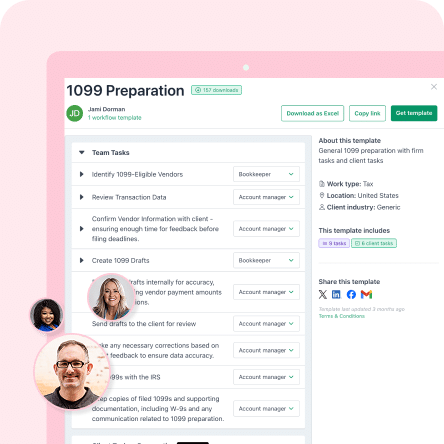
And, of course, accounting teams looking to remove some of the follow-up burden from their admin can use Financial Cents’ client portal to automatically send document requests and reminders on a schedule, so a missing W-2 or bank statement gets chased by the system—not a person.
Protecting Bookkeepers and Tax Preparers
An admin’s filter doesn’t stop at the owner’s desk. During the busy season, bookkeepers and tax preparers need protection from the same noise.
A preparer who is deep into a return doesn’t necessarily need to know that a client just emailed asking when their documents will be reviewed, and a bookkeeper working through a reconciliation doesn’t need to stop because someone has a question about an appointment. The admin can absorb some of that back and forth, but the better goal is to prevent unnecessary interruptions from reaching the production team in the first place.
That’s why Anne-Marie Kaden builds in pre-tax-season runway for new hires, treating employee onboarding as a deliberate investment in getting team members ready before they’re thrown into the deep end. New hires at her firm, Tiny Paws Bookkeeping, spend roughly six months training in tandem with her or her manager before they’re fully on their own. They join weekly sessions, sit in on client meetings to observe and practice, and eventually lead calls while still being watched by someone more senior.
 Anne-Marie Kaden
Otto’s team stays coordinated throughout the year, so things don’t run any differently once busy season hits. Specialized Accounting runs a Tuesday and Thursday morning “lineup” every single week, which is essentially an all-hands where one team presents on something for ten minutes (a new client, a new tool, a process fix, etc.), and Thursdays end on a lighter note with a team-building question of the day.
Tyler Otto
Layered on top of that are dedicated Slack channels for quick wins, random updates, and casual banter—deliberately separate from the channels where deadline-driven client work happens.
The overarching goal is to keep the commotion of busy season from hitting every bookkeeper and tax preparer as an unfiltered stream. Instead, it gets absorbed into a rhythm the team already trusts—a known time and place where updates appear, rather than a constant scroll of pings competing with actual work.
Both approaches are built on the same underlying principle. An admin’s triage isn’t just a filter protecting one inbox at the top of the org chart. Done well, it’s infrastructure that keeps the whole team’s attention on the work that actually requires it.
Three Phrases That Buy You Time with a Demanding Client
When a client wants an answer right now, you don’t always have to give them one immediately. Sometimes the most useful thing you can offer is a clear next step:
- “Let me check on that and get back to you.”
For when you need to confirm with a bookkeeper, preparer, or owner before responding (without pulling them away from focused work just because the client asked first). - “I want to make sure I give you the right answer. I’ll confirm that with the team and follow up.”
For questions outside your authority. You’re not saying, “I don’t know.” You’re routing the question to the person who can actually answer it. - “We’re working through that now. I’ll update you as soon as I have something concrete to share.”
For status requests when there’s no meaningful update yet. It sets a clear expectation without creating another interruption for the team. - The principle: Don’t promise an answer just to end the conversation. Promise a next step you can actually control.
The Calm Voice in the Storm
Sometimes, triage is not about routing, deferring, or escalating anything. It’s just staying calm enough, consistently enough, that the people around you emulate your composure instead of feeding off your stress.
Busy season runs on deadlines and adrenaline—and that’s not totally avoidable. Someone has to be the person a panicked client or a frazzled teammate can go to without adding more heat to the situation. More often than not, that’s the admin. Admins can sit with a client’s financial anxiety or a teammate’s exhaustion, without absorbing it, minimizing it, or making it worse.
This calming effect is baked into the culture at Bookkeeping for Good. “A lot of clients tell us that we make them feel really calm,” Miller Furgeson says. “[We] have this calming effect. When things go wrong, we always approach it with, ‘It’s gonna be alright, we’ll get this figured out; we can help you.’”
She considers it part of the firm’s unique value. Payroll, she points out, might be the one true accounting emergency, since people need to be paid on time; almost everything else that feels like a crisis isn’t one, especially when someone in the room is steady enough to say so credibly.
For Kaden, this steadiness comes from being conscious of the emotional weight money conversations carry.
Anne-Marie Kaden
Drawing from her experience in the pet industry, she explains that having these conversations effectively means approaching nervous clients “just like you would a scared dog.”
Some clients are afraid of what their numbers will say. Others find it energizing. Either way, part of the admin’s job is reading the disposition of the client in front of them before they start talking.
For Jenkins, that means steering clear of judgment. “I ask questions because I simply need an answer,” she says. “I’m not asking because I’m judging you, because whatever you do with your money is what you do with your money.” This kind of framing lets clients open up about a messy situation instead of getting defensive.
These skills are a form of triage in their own right: deciding, in real time, whether the person in front of you needs information, reassurance, or simply to feel heard.
Why a Triage System Takes Pressure Off the Whole Firm
The problem with Helle’s chaotic first Q1 was that no one yet knew how to sort what came in, so every new client, every document, and every question landed with the same weight on the same desk, at virtually the same time.
By the time she rebuilt her workflows that summer, the firm had gotten better at deciding what deserved immediate attention, what could wait, and whose desk it belonged on.
An admin who filters well doesn’t just protect their own sanity through April; they change what the owner’s day looks like, what the team’s week feels like, and what a client experiences each time they reach out with a question. That is how the admin ensures that the pressure is no longer everyone’s problem, all at once.



Enter your email address to receive new issues of the magazine straight to your inbox.