Firm owners who hold onto everything might think they’re being helpful, but they’re actually capping their own growth. Here’s how the most effective ops leaders get the work, and the fear of delegation, out of the founder’s head.
Tyler Otto knows delegation is an essential component of strong leadership. He’s also terrified of it. After all, if he hands off everything he’s still holding onto, what’s left for him to do? And more than that, what will his team think of him?
Otto’s self-proclaimed tendency to hoard work actually inspired a running joke at Specialized Accounting where a photo of his own face stands in as the company’s bottleneck symbol. It’s also behind the team’s internal motto: #removethebottleneck.
Staff have spent the year picking apart the small, undocumented tasks Otto was still doing himself—things many of them didn’t even know about. Their ultimate goal? Getting the firm to a place where it can operate without its founder. But turning that goal into a reality requires more than a shift in operational protocols. It really starts with culture: creating an environment where staff feel safe enough to act without asking first.
“My staff doesn’t live in fear of me reprimanding them for seeing an opportunity and just going for it and fixing it,” Otto says.
When “busy” becomes a blocker
Founders rarely think of themselves as the bottleneck. They think of themselves as busy, which feels like a normal part of running a business. Eventually, though, “busy” becomes a blocker. And for firm owners who want their businesses to grow, it’s crucial to get this blocker out of the way as quickly as possible.
Katie Helle hit that barrier almost immediately after founding Scaled Accounting Solutions. She had expected a slow ramp, so she hadn’t thought much about documenting her processes and workflows, figuring that could come later. But business took off way faster than she anticipated, which put her in a pinch when she started bringing on staff.
Anne-Marie Kaden ran into the same wall at Tiny Paws Bookkeeping. “It was spotty a year ago,” she says. “We definitely had holes in our training as a result of not having good processes or good workflows.”
Whether you plan for it or not, growth has a way of rooting out weak operational structures. And unfortunately, many firm owners find out the hard way that fixing your foundation is much more difficult in the moment, when you’re already overextended and your newest hire has nowhere to turn to get answers about a process that only you know how to do.
Documenting to declutter
The solution to this all-too-common growing pain is simple. Of course, simple doesn’t necessarily mean easy. It starts with extraction: writing down everything that currently exists solely in the owner’s head. It’s not glamorous, and it might not feel like important work while you’re doing it. But documentation is the precondition for delegation, because nobody can pick up work that doesn’t have context, clarity, and visibility.
Dave Kersting learned that the hard way at Capovario. When he finally took the time to put his processes down on paper, his team’s response reinforced just how necessary it was, telling him, “This is all over the place, Dave. This is disorganized.” For him, documentation was just the beginning. The exercise also created the space the team needed to shore up their processes and make the entire firm run more smoothly and efficiently.
Melissa Miller Furgeson, who’s run Bookkeeping for Good for more than a decade, doesn’t mince words when doling out advice for anyone early in their journey as a firm owner.
5 Signs Your Firm’s Owner Is the Bottleneck (Even If They Don’t Think They Are)
- The owner is the only one who can answer certain client questions. If a client calls with a question and the only good answer is “let me check with the owner,” then there is still critical knowledge stuck in one person’s head.
- New hires only learn by shadowing the owner, not by following a documented process. If onboarding hinges on observing the founder in action, your firm doesn’t have a system. You have an apprenticeship that won’t scale.
- The owner still handles decisions your team could make on their own. If the owner’s calendar is full of approvals that don’t actually require their judgment, that’s bandwidth they’re spending on control for the sake of control.
- Your team asks permission more than they propose solutions. If nobody fixes anything without checking with the owner first, the culture isn’t teaching them to think and act independently.
- The owner doesn’t realize how much more they can do. Of all the day-to-day tasks and decisions that eat up their day, how many truly require the owner’s expertise or judgment? Some owners simply need help recognizing the items that could realistically come off their plate, and they’re often surprised by how much they are unnecessarily holding onto.
Building the trust muscle
Getting the work out of a founder’s head is one thing. Having the trust and confidence to actually disagree with them is another. That’s where an experienced ops leader’s value really shines.
Kaden intentionally makes room for this type of healthy disagreement in one of her firm’s most important processes: hiring. Rather than choosing a candidate alone, she brings one of her managers into every interview.
Kersting is also big on trust—so much so that he extends it before it’s earned rather than making people prove themselves first. “I trust you to do this,” he tells new hires. “I trust you to reach out to me if you have questions.”
At Specialized Accounting, that same kind of trust is key to making “remove the bottleneck” more than a company hashtag. Because a team that feels safe enough to tell the founder what isn’t working is also a team that feels safe enough to fix a problem without asking first.
Making the work visible
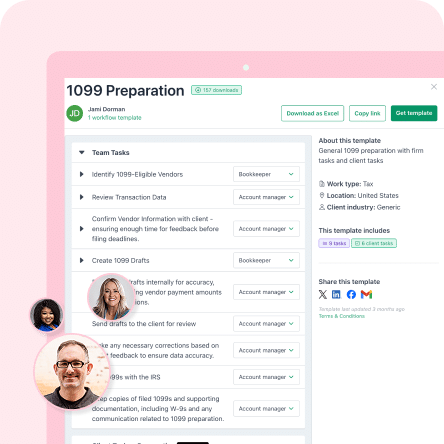
All of that being said, documentation and trust only go so far without a way to actually see the work. That’s where operational infrastructure comes in: the systems that let a team, and a founder, know what’s happening across every client without anyone having to ask.
For Laraine Hutcherson, that visibility is essential to keeping her team of 15 people at Strength in Numbers Co. organized and effective. And one of the main ways she gets everyone on the same page is by leveraging her firm’s practice management software as the shared source of truth.
Hutcherson knows the system will always tell the team exactly what needs to happen next, which means she doesn’t have to be the one holding it all it together, all the time. It’s a major win for efficiency, but the bigger victory is peace of mind.
What it costs the founder to let go
It’s tempting to think that once the right systems are built, the right protocols are in place, the right people are in seat, and the right culture has been cultivated, firm owners will have no problem “handing the keys” to their trusted ops leaders and other team members. In practice, though, that isn’t always the case. Like Otto, many still resist—sometimes subconciously—out of the fear that they will somehow delegate away their purpose.
For Hutcherson, this resistance shows up as a personality trait she has to actively work against. “As an A-type personality, the biggest challenge is letting other people do the work,” she says.
For Kaden, the answer wasn’t a mindset shift so much as the time and space to train team members to perform at the high standard she expects of herself. New hires at Tiny Paws Bookkeeping spend roughly six months working directly alongside her or her manager before they start handling client accounts on their own.
For these founders, delegation is something they built toward slowly, intentionally, and often a bit reluctantly. Handing off processes is in itself a process, and it’s important for firm managers and ops leaders to approach this evolution with patience—allowing owners the room they need to delegate with full confidence. In the end, the entire firm will be stronger when the founder is totally invested in this new operational model.
From patience to payoff
The payoff of that patience is a team that can truly function independently. At Tied Out Books, Tamra Helton talks about where she wants her people to end up in nautical terms—fitting for a firm that actually describes its service offerings using terms like “ships” and “voyages.” One employee, she says, is “on the way to being a quartermaster and then a first mate where she can actually run the firm for me.”
Regardless of terminology, this is the bar firms should be aiming for. To those just beginning their delegation journey, it might sound like a lofty endeavor. But with the right mindset and support, removing the bottleneck is possible, even if it’s painful at first. Just ask Otto.
Take our 1-minute diagnostic quiz to find out what’s really holding up your workflow (and how to fix it).
Take the Free Assessment