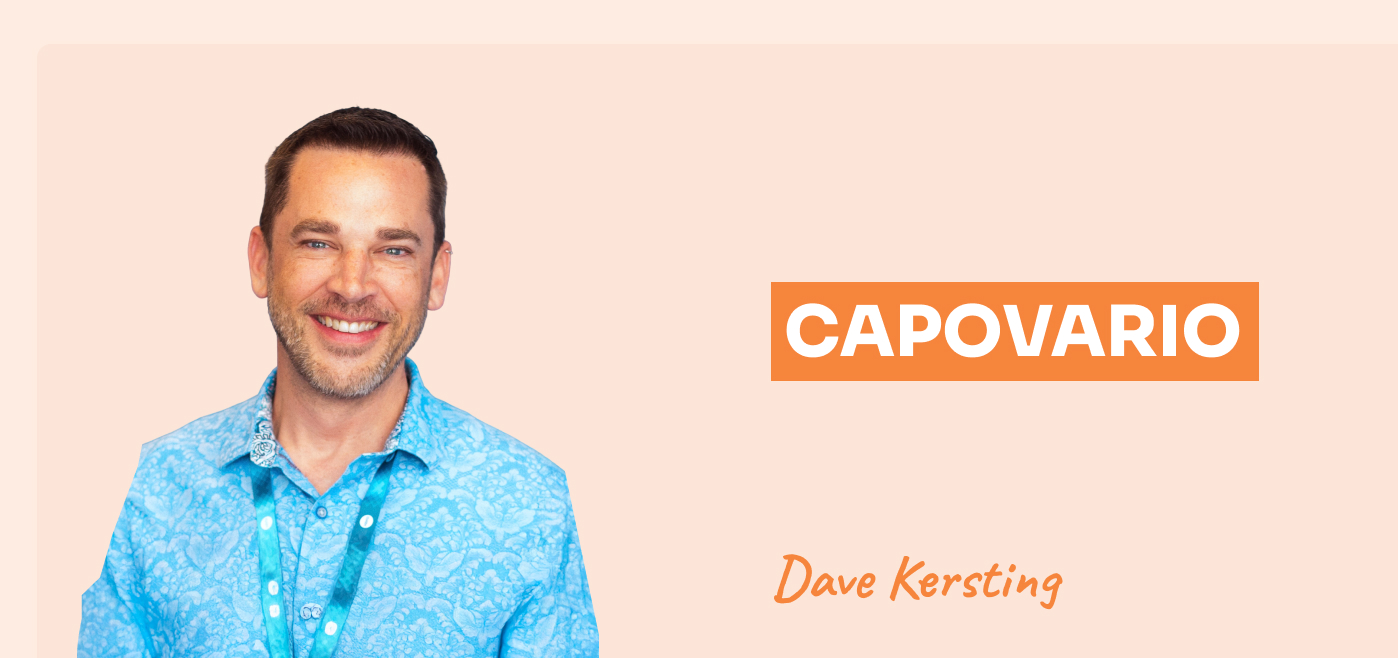
Dave Kersting opened Capovario for his mom. Three years after losing her, he’s discovered the firm has an even bigger purpose than the one it started with.
Three weeks after his mother died in 2023, Dave Kersting walked onto the main stage at the Scaling New Heights conference to give a talk about community. He thinks he failed that day. He was emotionally numb, he says, and the words came out flat—even though multiple people came up to him afterward to tell him otherwise.
His mother had been the reason he started his firm, Capovario, in the first place—the reason he spent so much time on the speaking circuit. He’d built Capovario, in part, so she’d never have to work again. And now, with her gone, he was forced to reckon with a question he hadn’t expected to face so soon: What is this firm for now?
The answer, it turned out, would take three months of deep introspection to tease out. Eventually, he would realize that even if Capovario had pivoted from its original purpose, it had not lost any of its original heart—if anything, that core essence had grown stronger and louder. And in this new season of life and business, it was time for him to embrace that essence fully.
But to understand how he arrived at this realization, you have to go back to the version of Dave Kersting who struggled to get out of his own way long enough to start the firm at all.
Seven Years of Hesitation
Kersting knew he wanted to start Capovario seven years before he actually got it off the ground. He just couldn’t bring himself to do it.
His original “why” was both simple and touching: he wanted to make sure his mother would never have to work again—to enable her to retire comfortably, enjoy time with her family, and travel to her heart’s content.
But what finally tipped him over the edge wasn’t ambition. It was a bad job—one filled with condescension, 12-hour days, and write-ups for everyone over one thing or another.
His mom, predictably, told him he could do it. His stepdad—a truck driver with a head for business—told him to put it on paper first, pushing him to answer foundational questions like, “What are you going to charge?” And, “How are you going to get clients?”
Kersting didn’t have those answers—at least not at first. But he had support, and he had one unanswered question that actually made him feel more confident taking the plunge: What’s the worst that could happen?
He launched Capovario at the start of the COVID pandemic—terrible timing on paper. But in practice, it was perfect. Remote work was suddenly the standard rather than the exception. Clients rolled in, and he hired two employees in the first six months.
From Free Audit to First Client
A friend referred his first prospective client—a business owner who needed help with a workers’ compensation audit. Kersting put together pricing. The client said no, pretty much on the spot. He couldn’t afford it.
Kersting drove down to his office the next day anyway.
“I said, ‘I’m here because you have a problem on a workers’ comp audit, and I am an expert in this. I’m just going to do the audit.’ And he’s like, ‘Well, I’m not paying you.’ And I said, ‘No, you don’t have to pay me. I just want to do it because what else am I working on today?’”
The client ultimately ended up saving a significant amount of money. He signed a two-year contract before Kersting even had a chance to send a follow-up.
That word—concierge—would become the firm’s signature, distinguishing it from what Kersting saw as the colder, more clinical category of “advisory services.” He doesn’t like that phrase. “Advisory” implies that he knows how to run someone else’s company, and he’s adamant that he doesn’t. What he can do is solve problems, connect dots, and bring in the right people and resources at the right time.
The firm’s name reflects a similar inclination toward the human touch. Capovario is two Italian words squished together, roughly translating to “diverse leader.” It’s meant to encompass the spirit of the brand, which emphasizes warmth, personality, and respect and appreciation for a wide array of beliefs and cultures. This ethos is reflected in everything the firm does, all the way down to their voicemail greeting, which was recorded by someone in the UK with a distinctive British accent. Kersting says people sometimes call just to listen to the pre-recorded message.
“They need an uplifting moment,” he says, laughing.
Three Connections, One Reality Show
The clearest illustration of Capovario’s concierge consulting in action is perhaps the most quirky.
One of Kersting’s clients, half-dreaming aloud one day, mentioned how cool it would be to have a reality TV show. A second client, in an unrelated conversation, mentioned working with someone at Netflix as a copywriter. A third turned out to be a production manager in California who’d worked on big movies and shows. Kersting connected the dots.
The result is the YouTube reality series Our 3 Dads.
Kersting tells the story with a kind of bewildered delight, as if he still can’t quite believe it happened. But the underlying logic is a perfect representation of how he runs his firm. He has a concrete company in Colorado that needs business; he has a home builder who needs concrete. So he introduces them. He has a summer camp client he eventually realized operates a lot like a construction company—archery is a job, just like a driveway is a job—and he starts job-costing accordingly. When clients need employee health insurance, dental coverage, or 401(k) plans, he coordinates the quotes himself and connects the clients with agents he trusts. He doesn’t bill for any of that work.
Passion Projects and Unconditional Trust
A firm that treats clients this generously can only function if the team behind it operates the same way. So Kersting built Capovario’s culture deliberately—and a bit unconventionally.
Nobody at Capovario has set hours. Team members work the hours they want and take time off when they need it—even occasionally calling off when it’s beautiful outside after a stretch of bad weather. Kersting credits Financial Cents for making this kind of trust operationally possible: when everyone can see what’s happening, people can more easily step away without things falling apart.
He also funds what he calls “passion projects”—community causes his team members care about, with no marketing strings attached. One team member crochets at her local church and noticed other women didn’t have supplies; Kersting told her to go buy them on Capovario’s dime (but refused credit on behalf of the company). Another team member loves taking his grandmother to get her nails done; Kersting suggested he invite her friends along too—all on the firm. Last year, Capovario was the top company sponsor of a local Pride event near Kersting’s home. His entire team showed up to celebrate because they wanted to—not out of obligation.
His hiring philosophy mirrors all of this. He once hired a team member with no accounting experience at all—someone who had never opened QuickBooks in their life—because the fit was right and they had a finance career goal that the role would help them reach. And he gives trust upfront, not after a probationary period.
“I think you have to trust and then give people the resources to communicate,” he says. “Make sure that they have a partner.”
A Fresh Direction
That culture—the trust, the systems, the team that can run without him—is what kept Capovario standing in 2023, when Kersting needed to step away after his mother passed.
In the stillness, he made some quick decisions about clients that, in hindsight, turned out to be the right ones. “I wasn’t looking at the financials,” he admits. Instead, he cut clients who were clearly not a fit for the kind of culture he wanted to nurture—and the kind of future he wanted to create for Capovario.
Little by little, those changes helped Kersting confront the bigger question lurking beneath the surface—the one that was the most uncomfortable and painful to answer. The original purpose for Capovario had been his mother. Now what?
The answer, when it came, wasn’t a new mission statement. It was a recommitment to something Kersting had been doing all along: giving. To his team. To their families. To his community. To clients.
Earlier this year, a prospective client reached out, went through Capovario’s full discovery process, and then admitted he couldn’t afford the engagement. Kersting didn’t charge him for the discovery. Instead, he met the client for lunch with a packet of homework—three steps the client could take on his own to get started. When he finishes, they’ll meet again.
Kersting’s team has gently asked whether this is the best use of his energy, considering everything else going on. He sees it as one more opportunity to put his money where his mouth is: to give back in a tangible way.
As a firm, Capovario has formalized this instinct. Fifteen percent of the firm’s annual income is given back to the community in the form of services—discounted, price-adjusted, or simply offered free of charge to startups that need help.
Retire Now, Work Later
On top of everything else he’s involved in, Kersting is writing a book. The working title is, “Retire Now, Work Later,” and the thesis is exactly what it sounds like.
Don’t wait to take the trip, see the country, do the thing that lights you up. Build your business intentionally, so that when you’re officially retired, you can keep doing the parts of the work you love most—events, mentorship, helping tiny startup clients—and leave behind the parts you don’t.
The vision he keeps coming back to is spending six weeks in London. Not a week, not two—six. Long enough to feel like he’s living there. He also jokes about opening a Canadian division so he can call himself an international accountant. But the joking has a kernel of truth. Capovario, now at five employees and over 30 clients, is being built deliberately to support that kind of life—eventually.
His focus word for the year is “believe.” It’s a carryover from the year his mother died. He keeps coming back to it, because he isn’t quite finished with it yet. It means believing in himself, in his team, and in what he’s building.
Outside of Capovario, Kersting reads Patricia Cornwell novels, dances, gets massages, and spends extra days in every city he travels to for work—turning conferences into miniature vacations. He grew up on a beach and considers Key West his favorite place in the world: warm, diverse, fun. Everybody gets along with everybody.
In a sense, it’s the same thing he’s trying to build at Capovario: a place where everybody gets along, where work doesn’t get in the way of life, and where keeping things small and intimate isn’t a limitation, but a feature.
The firm Kersting once dreamed of building so that his mother could fully enjoy her life has become something larger than that original wish: a vehicle for letting other people enjoy life, too. His team. His clients. And eventually, Kersting himself—in London, six weeks at a time.
He still thinks he failed on that conference stage in 2023. The people who came up to him afterward knew better. He hadn’t failed at all. Because through that vulnerability, he found the clarity he needed—he found a new reason to keep going, keep giving, and keep believing.
Capovario is based in Denver, Colorado. Learn more at capovario.com.

Enter your email address to receive new issues of the magazine straight to your inbox.