
Jan Haugo spends more than 40 hours a week studying, teaching, and building with AI. But, she still finds it completely overwhelming—and she doesn’t expect that feeling to go away anytime soon.
Jan Haugo has her nose buried in AI more than 40 hours a week. It is, functionally, her entire job: she builds tools, teaches masterclasses, runs bootcamps, advises firms, and installs systems. She’s about as far up the AI adoption curve as anyone else in the accounting profession.
And yet, she finds it completely overwhelming.
 Jan Haugo
It’s not the pitch you’d expect from someone who sells AI training for a living. Most people in her position are selling relief—the knowledge and skills that will make the overwhelm go away. But Haugo is selling something more honest: a way to work inside the overwhelm, because the way she sees it, that feeling is never going away. It is, in her words, “the new normal.” Now, she says, the task at hand is learning how to move forward anyway.
All in on AI
Around 2010, Haugo loaded 15 document scanners into her car and drove them out to her clients, one by one, to install them herself.
Those clients were still on desktop software, and she had migrated her firm to the cloud early—early enough to land on Intuit’s Accountants Council back when it was still a novel distinction. To work the way she wanted to, she needed her clients to make the move, too.
So, she bought the scanners, programmed each one so a client only had to set a document down and press a button, and watched the files appear automatically into the digital vault where she needed them to live. For her, this setup was simply the most efficient way to run the firm, but for her clients, it was absolutely mind-blowing.
Jan Haugo
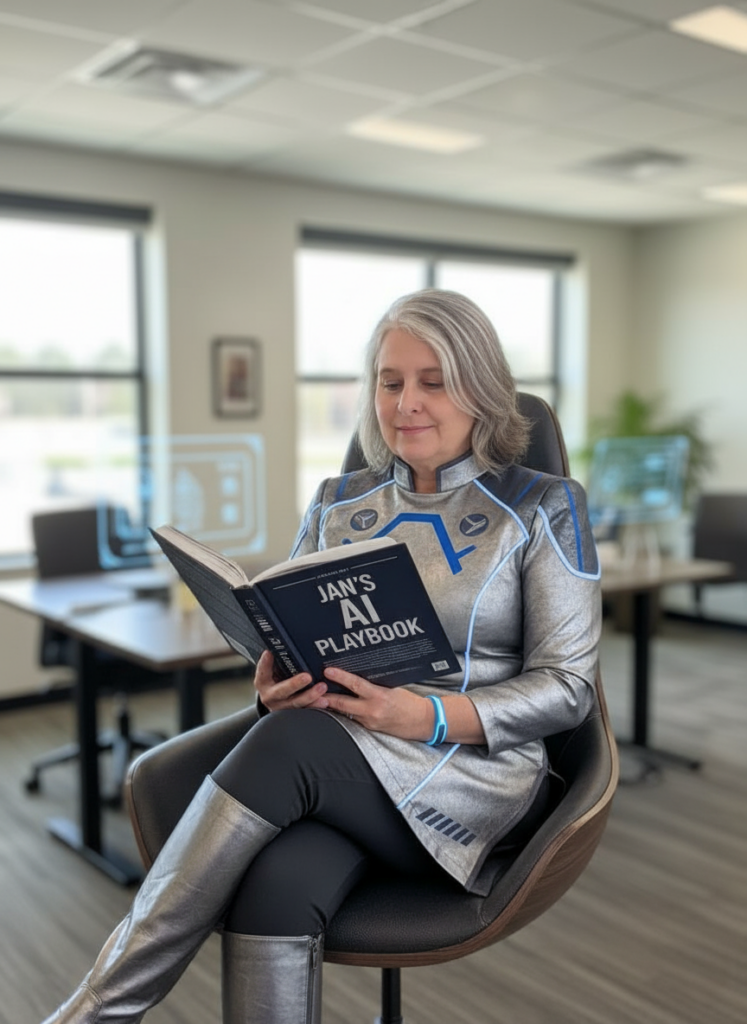
Haugo’s path to becoming a digital pioneer was not a short one. She got into accounting young and knew almost immediately it was her professional calling. She was also a single mother, and it took her ten years to finish her degree—a deadline she set against her own kids’ educational milestones.
“I didn’t want to be walking down the graduation aisle with my kids,” she says with a chuckle. “I wanted to be there before them. And I did, one year before they graduated.”
She ran her own firm for several years before transitioning to building out client accounting services departments inside other firms. Then AI exploded onto the scene. She started playing around with it and quickly became obsessed. So when her last consulting project wrapped, she decided to pivot.
Jan Haugo
Today, she runs SmartAccountant.ai, where she teaches accounting firms to adopt artificial intelligence through a mix of free and paid programs: a complimentary live masterclass she calls “the magic show,” a paid multi-day bootcamp, implementation sprints, and a done-for-you service where her team comes in and builds custom tools inside a firm. Much like the accountant hauling scanners out to her clients 15-plus years ago, Haugo still considers herself a harbinger of innovation—the early adopter lighting the way for others, eagerly watching for the moment it clicks.
The Email Trap
Every time someone tells Haugo that they’re using AI to draft emails, it takes every ounce of her willpower not to immediately exit the conversation.
Jan Haugo
It’s not that she thinks her peers shouldn’t write emails with AI. It’s just that this widely embraced use case falls somewhere in the AI foothills, and it seems like the bulk of the accounting profession has set up camp there indefinitely, refusing to climb the mountain where the biggest benefits await.
In fact, according to Financial Cents’ recently published State of AI in Bookkeeping & Accounting Report, the industry’s three most common AI use cases are drafting client emails, summarizing documents and meetings, and answering research questions—the exact tasks Haugo waves off. Reconciliations and returns sit near the bottom of the ranking, and nearly a quarter of firms using AI still aren’t touching a single core accounting task with it.
The 3 Most Common Uses of AI in Accounting Firms
Haugo pushes the firms she works with to go deeper. One example she’s seen is an AI-supported payroll tie-out: a W-3 reconciled against the general ledger, to the penny, for a 25-person company operating across multiple states. With AI, a full year could be done in under ten minutes.
Another example is an AI general ledger reviewer that can read an entire year of transactions in about 15 minutes, flagging details that even a trained human eye might overlook (e.g., an owner’s draw booked as a distribution instead of payroll or an expense line spiking outside of the norm).
Jan Haugo
That argument is a key aspect of the overarching reframe she teaches in her courses.
“I keep saying AI is a collaborator, it is not a tool,” she says. “I hear everybody saying AI is a tool, and I’m like, ‘No, it’s not.’”
To hammer home this point, she encourages her pupils to think about how they’d work with a colleague sitting next to them. You would give them context and details—any relevant information that would help make the work easier and faster for them. (Though you wouldn’t just bombard them with anything and everything that might be useful.)
“Why wouldn’t you give that to a collaborator?” she argues.
Phase Zero
If the goal is using AI to build comprehensive systems rather than handle one-off tasks (and Haugo strongly argues that it should be), then the obvious question is where to start. Haugo’s answer is perhaps a bit underwhelming, especially for anyone who’s anxious to hit the ground running.
Before starting their trek from the foothills to the mountains, Haugo advises firms to complete what she calls “phase zero.” That means addressing security first and foremost (i.e., how you handle your firm’s and your clients’ most sensitive information). Then comes data organization.
AI needs two things to be successful, Haugo explains: data and context. Most firms have their data scattered across multiple systems and formats, but it needs to live in one or two the AI can actually read. Many firms (especially older ones) also have some degree of what Haugo calls “data debt”: files sitting in folders that go back a decade or more.
Jan Haugo
Her solution: archive it, store it, and get it out of the way.
Then there’s the prompting problem. The mistake she sees most often isn’t asking too little of the AI, but dumping too much on it without clear direction. If you give it a 50-page document and type “summarize this” into the chat, you’ve written a terrible prompt. Instead, learn how to create clear, detailed prompts that tell the AI exactly what to look for. Be specific; be measurable.
“As accountants, we do that all the time,” Haugo says. “We’re just not used to telling our tools to do this.”
But perhaps the biggest item on any accounting professional’s pre-AI-journey checklist is acceptance, specifically with regard to the overwhelm. Because as much as she’d like to offer her accounting brethren words of comfort, the reality is that the rate of change isn’t slowing down anytime soon.
Jan Haugo
What you can do, she says, is better manage that overwhelm. Focus on one thing at a time, make a plan, and move forward. It’s all about putting one foot in front of the other.
And while Haugo certainly encourages proactivity, she cautions against rushing the process. Breaking it down into smaller chunks is the better approach, she advises, and the data from the report backs that up.
Perhaps a bit surprisingly, when asked about the biggest barrier to getting more out of AI, most of the survey respondents who contributed to the report didn’t point to cost or trust. Instead, they blamed time. Time to learn it. Time to implement it. Time to test and tweak it. It was the number-one roadblock by more than double the next answer.
Haugo’s response is not to promise that barrier away, but to reframe what it actually is: not a wall you get over once, but a permanent condition you adjust to forever.
In the permanence, however, lies release. If this isn’t something you can conquer once and forget about, then why spin your wheels trying to overcome it all in one big push?
“That’s kind of a train wreck,” Haugo says, referring to a full-steam ahead approach.
Instead, she advises, start small: by teaching the AI to sound like your firm, for example, because your firm and the firm down the street should not get the same output. Then, move methodically, tackle one area at a time, and—crucially—involve the people doing the work.
This is where she breaks, hard, with how most firms actually adopt AI. The report revealed that adoption is overwhelmingly top-down, with leadership driving it at more than half of firms. By and large, it’s not starting on the ground floor with the staff, and Haugo believes that’s exactly why it often fails.
Recent research on stalled AI rollouts supports that theory, showing that adoption tends to stick when it is driven by the people doing the work rather than mandated by leadership.
Jan Haugo
Her simple solution: let the people in production tell you where they need it.
“They’re gonna be the best [resources],” she says.
Another common question is whether firms need to build AI-supported workflows from scratch, or if it’s possible to plug the technology into their current processes. Haugo’s best answer is that it depends. While AI will almost certainly change your workflows in ways that require a degree of rework, that doesn’t necessarily mean you’ll need to rip out everything and start fresh, especially for workflows that are, well, working.
She uses accounts payable as an example. She could build an AI agent to replace a paid tool she already trusts, but should she? Someone has to maintain whatever she builds, and that someone will more than likely be her. So, a full rebuild probably isn’t worth it in the end.
If building or implementing a new solution will create more work than it saves, that should be a red flag, Haugo says. Generally speaking, the efficiency gains you see from technology should be obvious and palpable. She points to the transition away from spreadsheets to practice management platforms as a clear example.
“Before Financial Cents came along, what did we do?” she says. “Holy moly, we had to do this all by hand. There were multiple spreadsheets…things were overwritten.”
Pro Tip: Jan Haugo’s Pre-Adoption Phase Zero
Before you dive headfirst into AI, be sure to:
- Lock down security and how you handle client documents.
- Consolidate scattered data into one or two places the AI can easily access and read.
- Clear your “data debt” (i.e., archive old files so the AI works from what’s current and relevant)
- Teach the AI to sound and act like your firm so it sounds authentic to clients.
Bookkeeper Buddy
When speaking about her AI concerns, Haugo is careful not to lean too hard into doom-and-gloom territory. But, she’s also well aware that it isn’t all sunshine and rainbows.
One of her biggest worries comes back to accounting professionals themselves, especially those just starting out. As AI takes over more and more entry-level work, how will the youngest professionals learn and develop?
This concern bubbled up in the survey data as well, with many respondents admitting they are afraid AI is silently absorbing the tedious first-pass work (e.g., coding, data-entry, and tie-outs) that junior team members used to learn on. If a machine does all of that, then where does the next generation get its reps? It’s a tough question, and one Haugo feels to her core.
And so do her clients. In fact, at one firm she consulted with, she actually helped build a solution to this exact problem (ironically, one that leverages AI). Junior staffers at the firm were feeling stuck. They were scared to ask the seniors basic questions, and understandably so. The seniors were getting short with them, indicating that they should have already known the answers.
To ease the tension and help the juniors stay productive, Haugo built the firm a custom GPT she named “Bookkeeper Buddy.” It was loaded with firm-specific knowledge on how the firm handled payroll, debits and credits, and other common processes. Most importantly, though, it was designed not to simply spit out the answers, but to make the user think.
“The Bookkeeper Buddy doesn’t just give the answer,” Haugo explains. “It says, ‘Well, let’s talk through this.’”
For example, a junior might ask how to book a vehicle sale with a trade-in and, instead of immediately supplying a number, Bookkeeper Buddy would walk them through the reasoning behind the answer.
The purpose behind Bookkeeper Buddy—protecting human judgment rather than automating around it—aligns perfectly with Haugo’s entire philosophy about what AI can be trusted with versus what still requires a human in the loop.
Jan Haugo
She draws the AI line anywhere emotion, context, and memory become critical. Templates are fine. A generic recap of a meeting or event is fine. But the moment a detail that can only be perceived by a human is crucial to the meaning or outcome—that’s where an AI-only approach becomes not fine.
To explain what she means, Haugo offers an example. If you were at a concert, in the front row, and the singer came down and handed you a guitar pick, then that memory and the context around it meaningfully impact your analysis of the experience. Those are the kinds of details that must be preserved so we don’t lose our ability to connect on a uniquely human level.
Jan Haugo
Whether you’re creating a memorable moment by tossing a guitar pick to a fan, comforting a patient who’s not feeling well, or reassuring a client who is nervous about their numbers, these moments of emotional connection aren’t possible without human empathy and judgment.
That’s one perspective the profession is remarkably aligned on, at least according to the survey results: 90% of respondents agreed that human judgment matters more, not less, as AI spreads. In fact, it was the single most agreed-upon statement in the entire study. Furthermore, only about one in five respondents said they trust AI output enough to use it with limited review.
Due in part to this shared mindset, Haugo predicts that this historically introverted profession will be challenged to become much better at the human parts of the job: communication, creativity, and presence.
The Next Generation

Zooming out even further—beyond the world of accounting and bookkeeping—Haugo says her most pressing concern about the proliferation of AI has everything to do with the next generation of humankind.
“My granddaughter was just born, what, 20 days ago,” she says. “And so I wonder, what does her life look like?”
And that brings up her largest reservation—an uncomfortable one for an AI evangelist to call out. Haugo lives in Scottsdale, Arizona, and all around her, enormous semiconductor plants are springing up like weeds after a summer monsoon storm—million-square-foot fabrication facilities built to power the machines that run AI. As she watches them rise into the triple-digit air, she can’t help but think about what the chips need to function.
Jan Haugo
Another concept that weighs heavy on her heart: Buckminster Fuller’s knowledge-doubling curve. Human knowledge, Fuller observed, took about a century to double back in 1900, and roughly 25 years by the end of World War II. According to Haugo, it now doubles every few hours, and she shudders to think about what that means for her granddaughter.
Jan Haugo
Of course, there are benefits to this shift as well—plenty of them. Haugo prefers to focus her energy there. Using an example from her personal life, she explains how AI helps her plan meals based on what’s in her fridge. The benefit, she explains, isn’t really the dish itself; it’s the mental load the AI removes by telling her what to cook.
When she doesn’t have to use any cognitive power on piecing together a recipe for tonight’s dinner, she has more brain space for being creative, being present, and engaging with the people in front of her. AI can’t do any of that, but it can help humans do more of it.
“How many times have you gone to a restaurant and you see people, and they’re both sitting there at the table, but they’re not looking at each other, because they’re both scrolling?” she says.
She urges those around her to resist falling into that sort of pattern as technology wedges deeper into our lives—to instead embrace all the best parts about being human.
Jan Haugo
Why Accounting Firms Need AI Policies and Human Judgment
For all the tools she’s built and all the masterclasses she’s enthusiastically hosted, Haugo’s biggest hope for the profession is a refreshingly modest, almost old-fashioned one. It is not about productivity. It is about protection.
“Getting my degree was, like, my proudest day ever,” Haugo says, “Because it’s such an honorable and ethical profession.”
She’s worked hard to climb every rung of her career ladder, first to become a bookkeeper, then a junior in a CPA firm, then an entrepreneur in accounting. What frightens her is the idea of all of that going up in smoke—of everything being reduced to models that churn out numbers.
Jan Haugo
Her charge to the people guarding the profession is simple: protect it.
There is one concrete place she thinks that protection should start, and the State of AI report backs up her case. The overwhelming majority of firms using AI have no written policy governing it, and a striking share have no plans to write one (even though, based on the same data, having a documented policy is the single strongest correlate with seeing a measurable return on investment).
Haugo sees that gap all the time in her courses, where she often runs live polls and watches owners realize, in real time, that they have no idea how their own teams are using AI.
Pro Tip: Write Your AI Policy
Here’s where to start:
- Find out how your team is already using AI (most owners genuinely don’t know, and that’s a huge risk).
- Build a living policy you can update as tools change, not a document you write once and file away.
- Being early beats being perfect. When formal guidance arrives, you’ll already be ahead of the game.
Which brings the story back to where it started: to the overwhelm that probably won’t ever go away completely, even for the guide who’s bravely leading others through the storm. The important thing, Haugo says, is to keep moving, even when the skies may never totally clear.
Speed is not the objective. In fact, rushing this transition might actually set you back even further. This actually gives accountants an advantage, Haugo surmises, offering her favorite metaphor for her profession’s relationship to change.
Jan Haugo
Accountants don’t really come out of their shells, she jokes, until after April 15. But she has seen what happens on the other side of that initial foray into AI, again and again, in the awe on their faces.
“Once you make that mental shift, you will take off like a rocket,” she says.
Jan Haugo is the founder of SmartAccountant.ai, where she trains accounting firms on AI adoption and usage. Learn more at smartaccountant.ai.



Enter your email address to receive new issues of the magazine straight to your inbox.